🪃 Roller coaster type Free
Boomerang
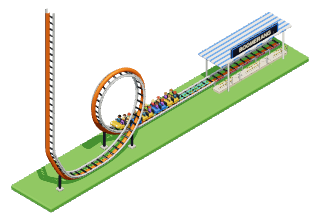
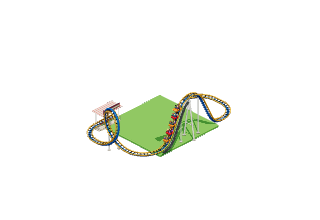
A shuttle coaster: the train runs out through its loops and up a spike until it stops, then rolls back through every element backwards.
- 101 m
- max height
- 5 × 4
- cars × seats
- $3.5
- default ticket
- Free
- free to build
In the game
The Boomerang is always a shuttle. Its track doesn’t come back round: it starts at the station and ends in a spike, and the train climbs until it stops and rolls back. The ride setting Runs says how many times it goes out and back before it stops in the station.
It can be launched from linear motors right after the station, or hauled backwards up a chain lift on a spike behind the station and let go. Every loop and corkscrew is ridden twice, once facing backwards, so a short track packs a lot of inversions, and riding backwards counts as more intense.
In Park Baron the Boomerang can rise 101 m above the ground under its track. It can build steep slopes, loops and corkscrews, vertical drops and top hats and launch track, but not tight turns. Its launch track pushes the train up to 121 km/h. Its trains run 5 cars of 4 seats, 20 riders a train, and its station is 5 to 8 tiles long. Track costs $95 a piece and the station $1,300; it costs $850 a month to run, and guests pay $3.5 a ride by default. The type adds 0.30 excitement to whatever the track earns, and its rolling friction is 0.010. Children are too short to ride it. It is free to build.
Its showpiece design, Full Circle, climbs 55 m, reaches 83 km/h and pulls 4.3 g, with 8 inversions over 242 m of track and a 43-second ride. It rates 8.42 excitement, 7.70 intensity and 6.12 nausea, costs $6,951 and fills 2 × 32 tiles.
The numbers
- Max height
- 101 m
- Station
- 5–8 tiles
- Train
- 5 cars × 4 seats
- Track piece
- $95
- Station cost
- $1,300
- Running cost
- $850 a month
- Ticket
- $3.5
- Type bonus
- +0.30 excitement
The ready-made designs
Every coaster type comes with a starter, a crowd-pleaser and a showpiece, at least one Light design (intensity 4.5 or under) and, except the gentle Junior, one Extreme (7.5 or over). These are the Boomerang’s, tested with the game’s own physics.
| Design | Height | Top speed | Max G | Inversions | Length | Excitement | Intensity | Nausea | Cost |
|---|---|---|---|---|---|---|---|---|---|
| RicochetLaunched through a loop and up a spike, then the loop again backwards. | 32 m | 70 km/h | 3.7 g | 4 | 106 m | 6.16 | 5.23 | 3.43 | $3,865 |
| RecoilHauled backwards up a lift spike and let go: two loops, a spike, and both loops again backwards. | 32 m | 82 km/h | 4.6 g | 4 | 180 m | 6.43 | 6.27 | 3.75 | $4,431 |
| Full CircleExtreme. Two loops between two vertical spikes, three runs: eight inversions, half of them backwards. | 55 m | 83 km/h | 4.3 g | 8 | 242 m | 8.42 | 7.70 | 6.12 | $6,951 |
| Yo-YoLight. A gentle 60 km/h launch up a short spike and back: no inversions, all giggles. | 21 m | 60 km/h | 3.3 g | 0 | 53 m | 3.67 | 3.74 | 0.94 | $3,105 |
Building tips
- Make the spike tall enough: if the train still has speed at the top, it shoots off the end and the test fails.
- The station must be the lowest point between the spikes, or the train can’t settle back into it.
- A second spike behind the station gives the backwards run somewhere to go and a longer ride.
The real thing
Real boomerang coasters pull the train backwards up a lift spike, release it through a cobra roll and a loop, up a second spike, and then run the whole course again backwards.
More coaster types
Every park has a story
Your park is waiting
The gates open tonight. Free to play, no install, no card needed.