🎢 Roller coaster type Free
Steel Looping Coaster
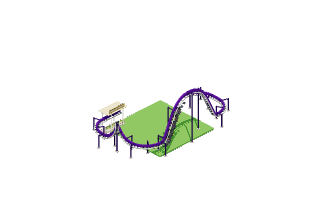
The all-rounder of the coaster yard: smooth steel rails that can climb steeply, dive steeply and turn riders upside down in vertical loops and corkscrews.
- 84 m
- max height
- 5 × 4
- cars × seats
- $4
- default ticket
- Free
- free to build
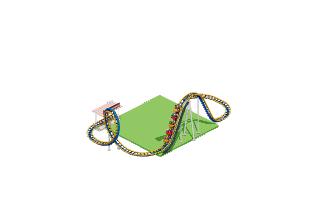
In the game
The Steel Looping Coaster is the type most players learn the editor on, because it can use almost every piece: chain lifts, steep slopes, banked turns, helixes, loops and corkscrews. The only things it can’t do are vertical drops, top hats and launches, which belong to the bigger steel types.
Each inversion adds excitement, but it also adds intensity and nausea, so a track with loop after loop quickly becomes a ride only thrill-seekers will queue for. Its own type bonus is the smallest of any coaster, so its rating depends almost entirely on the track you lay: speed, the size of its drops, airtime, length and inversions.
In Park Baron the Steel Looping Coaster can rise 84 m above the ground under its track. It can build steep slopes and loops and corkscrews, but not tight turns and vertical drops and top hats. Its trains run 5 cars of 4 seats, 20 riders a train, and its station is 5 to 9 tiles long. Track costs $90 a piece and the station $1,200; it costs $900 a month to run, and guests pay $4 a ride by default. The type adds 0.20 excitement to whatever the track earns, and its rolling friction is 0.010. Children are too short to ride it. It is free to build.
Its showpiece design, Grand Serpent, climbs 25 m, reaches 82 km/h and pulls 4.4 g, with 4 inversions over 473 m of track and a 43-second ride. It rates 9.98 excitement, 7.17 intensity and 7.87 nausea, costs $11,535 and fills 26 × 27 tiles.
The numbers
- Max height
- 84 m
- Station
- 5–9 tiles
- Train
- 5 cars × 4 seats
- Track piece
- $90
- Station cost
- $1,200
- Running cost
- $900 a month
- Ticket
- $4
- Type bonus
- +0.20 excitement
The three ready-made designs
Every coaster type comes with a starter, a crowd-pleaser and a showpiece. These are the Steel Looping Coaster’s, tested with the game’s own physics.
| Design | Height | Top speed | Max G | Inversions | Length | Excitement | Intensity | Nausea | Cost |
|---|---|---|---|---|---|---|---|---|---|
| CometA 20 m drop into a vertical loop, then a banked spiral climb: the classic first looper. | 20 m | 79 km/h | 4.5 g | 1 | 246 m | 6.52 | 5.93 | 4.75 | $6,114 |
| Corkscrew CanyonA zero-g corkscrew off the lift, a spiral dive and two vertical loops. | 25 m | 82 km/h | 4.4 g | 3 | 350 m | 8.27 | 7.99 | 6.81 | $8,595 |
| Grand SerpentTwo lift hills, two zero-g corkscrews, two spiral dives and back-to-back loops. | 25 m | 82 km/h | 4.4 g | 4 | 473 m | 9.98 | 7.17 | 7.87 | $11,535 |
Building tips
- Put a loop at the bottom of the first big drop, where the train is fastest: a slow train stalls in a loop and fails its test run.
- Follow the loops with a gentle banked turn or a small hill so the nausea from lateral G has time to settle.
- Two lift hills with a block brake between them let you run a second train and double the riders per hour.
The real thing
Real looping steel coasters grew out of the tubular steel track of the 1970s, which made smooth vertical loops practical; the clothoid-shaped loop, tighter at the top than at the bottom, keeps the forces at the bottom bearable.
More coaster types
Every park has a story
Your park is waiting
The gates open tonight. Free to play, no install, no card needed.