By Avni YayinUpdated
The lift hill: storing energy
Almost every ride starts the same way: a chain or a cable pulls the train up the lift hill, slowly, so the riders can see how high they are going. What the motor puts in is stored as potential energy: the train’s mass, times gravity, times the height. It is the only energy a classic coaster gets, and the rest of the ride spends it.
Launched coasters skip the climb. Linear motors in the track, or a hydraulic or pneumatic catapult, fire the train out of the station at full speed in a few seconds, and it can then climb a hill taller than any lift would allow.
The drop: height becomes speed
On the way down, potential energy turns into kinetic energy (speed). If nothing were lost, the speed at the bottom would be v = √(2 g h), the same for a light train and a heavy one: about 34 m/s (124 km/h) after 60 m, and about 55 m/s (200 km/h) after the 157 m that Park Baron’s Giga Coaster may climb. Our g-force calculator works it out for any height.
From then on the train trades speed back for height at every hill. It can never climb as high as the lift again, because something is always lost on the way.
Friction and air: where the energy goes
The wheels rolling on steel, the bearings and above all the air pushing on the train turn some of the energy into heat and noise. Air drag grows with the square of the speed, so the fastest part of the ride loses the most. That’s why every hill after the first is lower, and why the last part of a long ride is often slower and twistier.
Park Baron models the same thing: every coaster type has its own friction (the wooden coaster clatters and loses the most; the giga the least), plus a drag that grows with speed. If you ask a train to climb a hill it no longer has the energy for, the test run stalls and names the piece where it rolled back.
Loops, and why they are teardrops
In a vertical loop the track must push the riders round the curve. At the top, gravity helps, so the train only needs enough speed that the riders stay in their seats. The trouble is a perfect circle: with just enough speed at the top, the riders would feel about six times their weight at the bottom. The early circular loops of the 1890s, such as Coney Island’s Flip Flap Railway, were famous for hurting necks.
The fix, first used on a modern coaster in 1976, is a loop shaped like a teardrop (a clothoid): the curve is tight at the top, where the train is slow, and wide at the bottom, where it is fast. The g-force stays much more even all the way round.
What riders feel: g-forces
Riders feel acceleration as weight. Sitting still is 1 g. In a valley at the bottom of a drop they are pressed into the seat with several g; over the crest of a fast hill they get lighter, and below 0 g they float up against the lap bar: the “airtime” coaster fans love. Side-to-side (lateral) g in fast turns is the least comfortable, which is why real track banks into its curves.
Designers keep strong forces brief. Standards such as ASTM F2291 allow more for a fraction of a second than for several seconds, and less for negative g than for positive.
Brakes and blocks: stopping safely
A coaster ends with brake runs: fins on the train pass between brake pads or magnets that slow it down, so the train always arrives at the station at a walking pace. Block brakes divide the circuit into sections, and a train may only enter a section once the one ahead has left it. That is what lets a busy coaster run two or three trains at once without them ever meeting.
See it in Park Baron’s editor
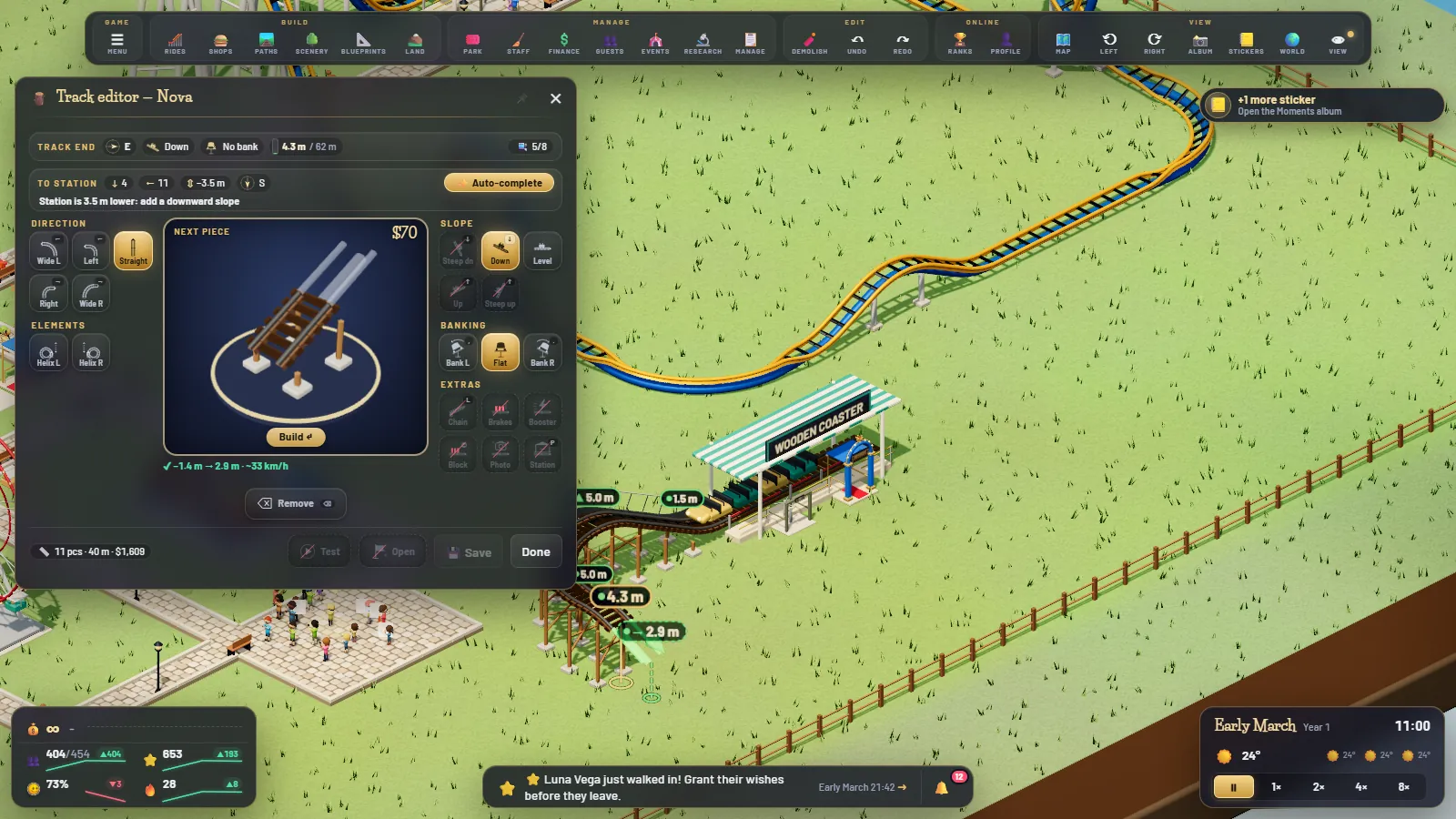
In Park Baron you build a coaster piece by piece and test-run it before it opens. The Graphs tab plots the speed, height and vertical and lateral g of the whole run, second by second, so you can see where energy goes and which curve pulls too hard. Every problem is named: a stall points at the hill, a block section at the missing brake.
Sources
- OpenStax, College Physics 2e, 7.4 Conservative Forces and Potential Energy
- OpenStax, College Physics 2e, 6.3 Centripetal Force
- A.-M. Pendrill, “Rollercoaster loop shapes”, Physics Education 40 (2005) 517
- Wikipedia, Vertical loop (history of circular and clothoid loops)
- ASTM F2291, Standard Practice for Design of Amusement Rides and Devices